
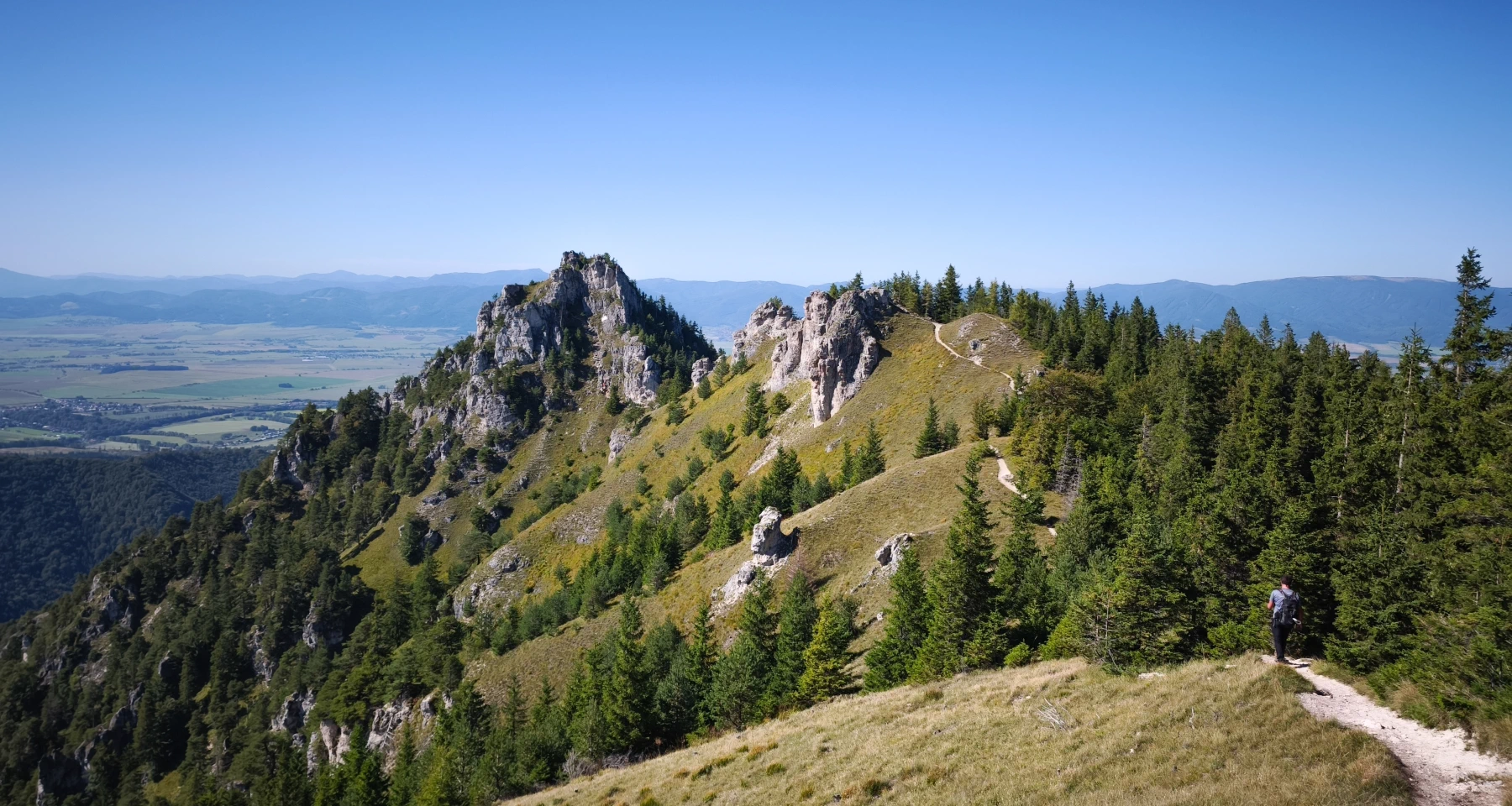
If you have ever traveled by car through the Turiec Basin, you have probably been captivated by the sight of two unmistakable hills. They are like siblings that complement each other. What happens when two absolute opposites meet in one mountain range? The result is a hiking experience you will not easily forget! The pair of iconic peaks Tlstá and Ostrá, rising above the picturesque Turiec Basin directly from the Gaderská and Blatnická valleys, offers a perfect mountain contrast. While one charms you with its vastness and tranquility, the other tests your courage on rocks and chains.
Geology and Caves
The Tlstá and Ostrá massif represents dominant rock formations of limestones and dolomites with deep canyons. The limestone bedrock of Tlstá is literally “holey”. There are numerous caves here that are important archaeological and zoological sites:
- Mažarná Cave: The most famous freely accessible cave in the Tlsta massif. It has a monumental entrance portal and in the past served as a settlement for Neolithic humans and as a shelter for the cave bear (Ursus spelaeus).
- Rare inhabitants (Bats): The cave is an important wintering site for several species of bats. Most often you can encounter the lesser horseshoe bat and the greater mouse-eared bat. For this reason, it is important to visit the cave quietly during the winter months so that sleeping bats do not wake up, which could be fatal for them in freezing temperatures.
Flora: A Treasury of Rarities
Thanks to the limestone bedrock and rugged terrain, we can find species here that do not grow on the acidic soils of the central part of the mountain range:
- Relict pine forest: On extreme rock edges and ridges, stunted pines survive, remaining here as a relic from the post-glacial period.
- Rare flowers: In spring, the symbol of this area blooms here – Slovak pasque flower. Later, alpine edelweiss, alpine aster and the rare shiny pink (Western Carpathian endemic) join in.
Fauna: Kingdom of Birds of Prey and Predators
The inaccessibility of the rock walls creates an ideal refuge for sensitive species:
- Tatra chamois: It was artificially introduced to this area in the 1950s. Although this is not its original habitat, the population thrives exceptionally well in the rocky walls of Tlstá and Ostrá.
- Birds of prey: In the rocky cavities nest the peregrine falcon and the Eurasian eagle-owl.
- Predators: The rugged terrain of the Gaderská and Blatnická valleys, which surround the massif, is home to the Eurasian lynx, which finds ideal resting places among the rocks.
1. Access and transport
- By car: From Žilina or Martin towards Turčianske Teplice, turn off to the village of Blatnica.
- Parking: At the end of the village of Blatnica, near the SNP memorial, there is a large paid parking lot (approx. €6/day). An alternative is the parking lot in the center of the village (approx. €3/day).
- By bus (SAD): Lines run from Martin. The best option is to get off at the stop Blatnica, terminus, which is right at the entrance to the valleys.
2. Recommended hiking routes
Most hikers choose the circular route to tackle both peaks at once, which takes approximately 6 – 8 hours (depending on fitness).
Option A: Classic loop (Recommended order for the views)
- Route: Blatnica – Gaderská dolina – Vápenná dolina (blue trail) – Mažarná Cave – Tlstá peak – Lubená – Zadná Ostrá (green trail) – Ostrá peak – Muráň – Konský dol (yellow trail) – Blatnica.
- Highlights: Along the way, you will see the huge Mažarná Cave and pass through the iconic rock window on Ostrá.
Option B: Direct Ascent to Tlstá
- Route: From Gaderská dolina by the blue trail through Vápenná dolina. It is a steep ascent that takes approximately 3 – 3.5 hours to the summit.
Option C: Direct ascent to Ostrá
- Route: From Blatnica by the yellow trail through Konský dol. It is a slightly shorter route than to Tlstá, but the final section to the summit of Ostrá is rocky and secured with chains.
3. Difficulty and technical sections
- Elevation gain: The entire loop has an elevation gain of more than 1,000 meters, making it a moderately difficult to difficult hike.
- Technical aids: Below the summit of Ostrá there are chains and rock steps. It is not extremely dangerous, but it requires a steady step and no fear of heights.
- Terrain: After rain, the limestone surface (especially in the area of Tlstá and Mažarná) can be very slippery.
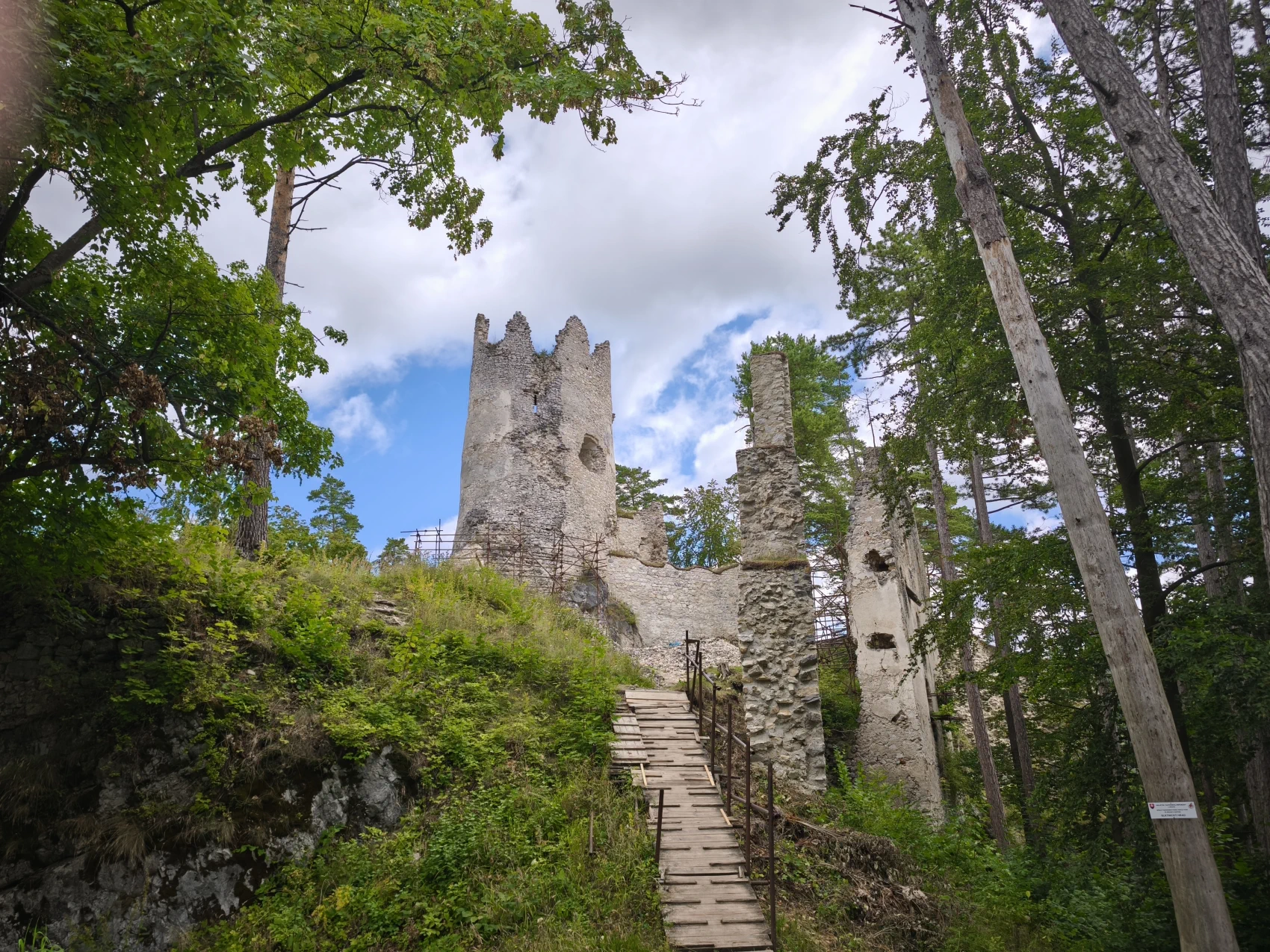
Tip for a detour: If you have time, right at the beginning of the hike you can take a short detour (approx. 15 minutes) to the ruins of Blatnica Castle, which is freely accessible from Gaderská dolina.
Map of the Tlstá and Ostrá area:
Photo gallery:


TEST